True crime news logo
  • Krimidex

Sign up for our newsletter and get the latest stories

Never miss the latest true crime news, reviews and top lists — plus new podcasts, series, films and books.

You can unsubscribe with one click from any email.

True crime news logo

The international true crime destination. Cases, documentaries, podcasts and travel routes.

© 2026 truecrime.news. All rights reserved.

Krimidex/agent-autonomi
ConceptInternational

agent-autonomi

The degree of independent decision-making capacity attributed to an intermediary or representative in criminal proceedings, particularly relevant in discussions of AI systems and automated tools in law enforcement.

agent-autonomi — Krimidex illustration

Definition

Agent-autonomi refers to the extent to which an intermediary—whether human or technological—can act independently without continuous direct supervision or control. In traditional criminal law, "agent" denotes a human person acting on behalf of another, and the law holds the principal liable for acts performed within the scope of that agency relationship. The concept of autonomy becomes legally significant when determining whether an agent's independent actions can be attributed to the principal, or whether the agent acted outside their authority.

In contemporary criminal justice contexts, agent-autonomi has gained relevance through the increasing deployment of AI systems and automated decision-making tools in law enforcement, surveillance, and forensic analysis. However, U.S. federal criminal law does not recognize artificial intelligence systems as legal agents capable of bearing criminal responsibility. The law continues to require proof of actus reus (criminal act) and mens rea (criminal intent) attributable to a human actor, not to autonomous systems themselves.

When automated systems are used in criminal investigations or prosecutions, legal accountability traces back to the humans who designed, deployed, or operated those systems. Courts examine whether a person exercised sufficient control over the technology and whether that person possessed the requisite criminal intent. The degree of system autonomy may be relevant evidence in determining whether a human defendant reasonably relied on automated outputs or whether they maintained effective supervisory control.

The absence of specific statutory provisions addressing agent-autonomi in federal criminal codes reflects the law's foundational principle that criminal liability requires human agency and culpability. As technology evolves, legislators and courts face ongoing challenges in adapting traditional agency doctrines to scenarios involving increasingly autonomous systems, but the basic requirement of human responsibility remains unchanged in criminal law.


Related entries

agent-autonomi

Cases

No cases yet.

Related articles

Forskere advarer: AI-agenter skaber usynlig kriminalitet

AI Agents Creating Invisible Crime, Researchers Warn

International researchers have identified critical vulnerabilities in AI agent systems that enable criminals to exploit them without detection. Google DeepMind's recent framework reveals how malicious web content can manipulate autonomous agents, with exploitation rates reaching 86 percent in documented tests.

Ny Ethereum-standard åbner for handel mellem AI-agenter

Danish Alert: AI Can Now Trade Without Human Approval

A March 2026 Ethereum standard has enabled artificial intelligence agents to conduct commercial transactions without human authorization for the first time. The development, based on ERC-8183 protocol, creates formal pathways for autonomous AI-to-AI trading — opening opportunities for both legitimate commerce and potential criminal exploitation.

AI-agenter kan nu handle på blockchain uden menneskelig kontrol

AI Agents and Financial Crime: What We Actually Know

Reports of AI agents handling large sums without human oversight have circulated online, but verified English-language evidence of actual crimes, arrests, or convictions remains absent from law enforcement records and credible news sources.

A weathered, wooden barrel half-buried in dense New Hampshire forest foliage, signifying the hidden evidence that eventually exposed serial killer Terry Peder Rasmussen through DNA analysis.

Bear Brook Murders: From Barrels to Serial Killer

In November 1985, a boy kicking over a barrel in Bear Brook State Park, New Hampshire, uncovered the remains of two victims—beginning one of America's most haunting unsolved cases. Thirty-two years later, genetic genealogy identified the killer: Terry Peder Rasmussen, a man who had evaded justice under at least five aliases.

A figure resembling Dennis Rader stands in a suburban Wichita neighborhood, next to an unmarked police car, as officers discreetly observe nearby homes.

The Church Leader Who Was America's BTK Serial Killer

Dennis Rader, a Lutheran church council president and Boy Scout leader in Wichita, Kansas, murdered 10 people between 1974 and 1991 under the self-created alias BTK—standing for his method: Bind, Torture, Kill. His double life remained hidden for three decades until a careless digital mistake led to his arrest in 2005.

A cracked Equifax logo on a glass door with reflection of anonymous figures in suits, symbolizing espionage and security failure, against the backdrop of a busy urban landscape.

U.S. Charges Chinese Military Officers in Massive Equifax Hack

U.S. federal prosecutors charged four members of China's People's Liberation Army on February 10, 2020, with orchestrating one of the largest data breaches in history. The defendants allegedly exploited a vulnerability in Equifax's systems to steal sensitive information from approximately 145 million Americans over a two-month period in 2017.

A figure resembling Osiel Cárdenas Guillén stands in front of a map of Mexico with marked routes, surrounded by cartel members in a dimly lit room, symbolizing the Gulf Cartel's network and influence.

Four Americans Kidnapped by Gulf Cartel in Mexico

Four U.S. citizens from South Carolina were ambushed and kidnapped by Gulf Cartel members in Matamoros, Mexico, on March 3, 2023, shortly after crossing the border. Two victims were killed and two rescued four days later, with authorities attributing the attack to mistaken identity.

A figure resembling Pascal Payet stands on the rooftop of a French prison, a helicopter hovering nearby with its blades spinning, symbolizing his infamous escapes.

The Helicopter King: Pascal Payet's Three Daring Prison Escapes

Pascal Payet, a French criminal convicted of murder during a 1997 security van robbery, made international headlines by engineering three separate helicopter escapes from prison between 2001 and 2007. Known by the alias 'Kalashnikov Pat,' Payet's audacious aerial breakouts—each lasting mere minutes—exposed vulnerabilities in European prison security and made him one of the continent's most wanted fugitives.

A figure resembling Rebecca Schaeffer poses on a bustling Hollywood street lined with star-studded sidewalks, capturing the essence of her rising fame before the tragedy struck

The Murder That Changed Stalking Laws

On July 18, 1989, actress Rebecca Schaeffer was shot and killed outside her West Hollywood apartment by obsessed fan Robert John Bardo. The 21-year-old's murder sparked a national conversation about stalking and resulted in groundbreaking legal protections that would reshape how law enforcement handles threats.

A figure resembling Oscar Pistorius is seated on a track starting block in an empty stadium, wearing his signature running blades, staring intently at the horizon as dusk falls.

The Fall of the Blade Runner: Oscar Pistorius Convicted of Murder

Oscar Pistorius, the celebrated South African sprinter known as the Blade Runner, shot his girlfriend Reeva Steenkamp four times through a locked bathroom door on Valentine's Day 2013. After a lengthy legal battle spanning years, he was ultimately convicted of murder and sentenced to over 13 years in prison.

A helicopter hovers above a high-security prison in France, ropes dangling as part of an audacious escape plan.

France's Master Escape Artist: The Rédoine Faïd Story

Rédoine Faïd, born in 1972, is a French criminal notorious for engineering multiple prison escapes using explosives and even a hijacked helicopter. His audacious breakouts and underworld exploits made him France's public enemy number one.

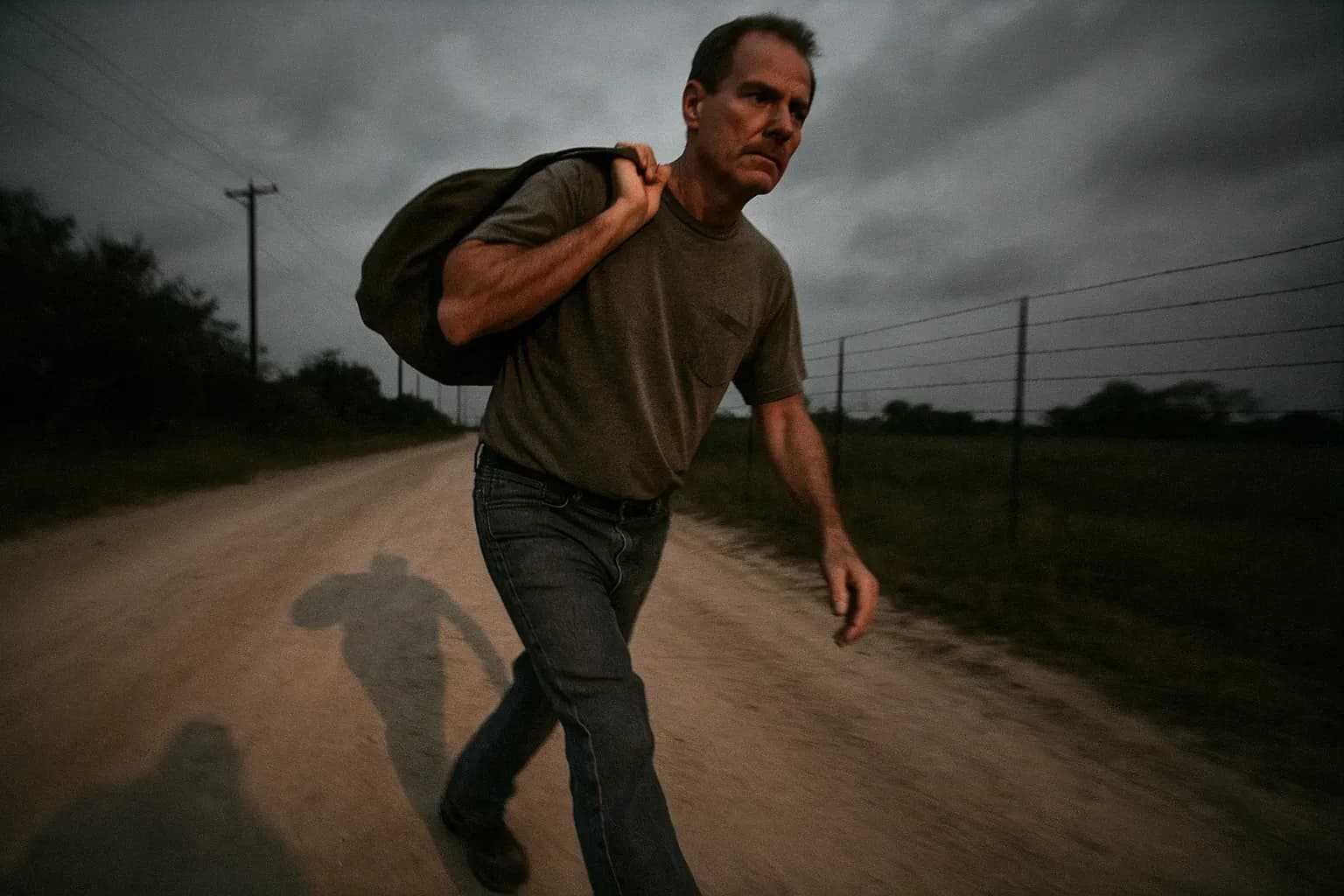
A figure resembling Richard Lee McNair casually strolls along a dusty road, dressed in civilian clothes, with a duffel bag slung over one shoulder, evoking his infamous escape artist persona.

Three Escapes, Three Methods: The Ingenuity of Richard Lee McNair

Richard Lee McNair, a former U.S. Air Force sergeant convicted of murder, escaped from custody three times between 1988 and 2006 using increasingly sophisticated methods—from lip balm to an ingeniously constructed escape pod—evading recapture for months each time.

Facts

Type
Concept
Jurisdiction
International
Legal reference
No specific U.S. Code provision exists; general agency principles apply under federal common law and individual criminal statutes requiring mens rea
Last updated
22 May 2026